
By Converteasy Team, Official Shopify Experts & E-commerce Strategists in Kerala; we help ambitious brands transition from manual selling to fully automated, high-converting online stores. With 5+ years of experience in Shopify development and 60+ successful Kerala brands launched, we specialize in Shopify store setup, automation, and growth-focused e-commerce strategies.
Published in Blog on March 24, 2026 | Last Updated on March 24, 2026
12 min read
Launching your Shopify store is exciting. But when you sit down to actually upload your first products, the questions start piling up fast: Which products should I list first? How do I price them? What photos do I use? How much information is enough?
If you’re a Kerala brand — selling anything from handloom textiles and Ayurvedic products to fashion accessories and homemade food — this guide is written specifically for you. Our team of Shopify developers in Kochi at ConvertEasy has helped 60+ local brands launch their first store, and we’ve seen every mistake in the book.
Here’s exactly what to do.
This is the most common mistake first-time Shopify sellers make. They wait until they have 200 products ready before launching. Don’t do this.
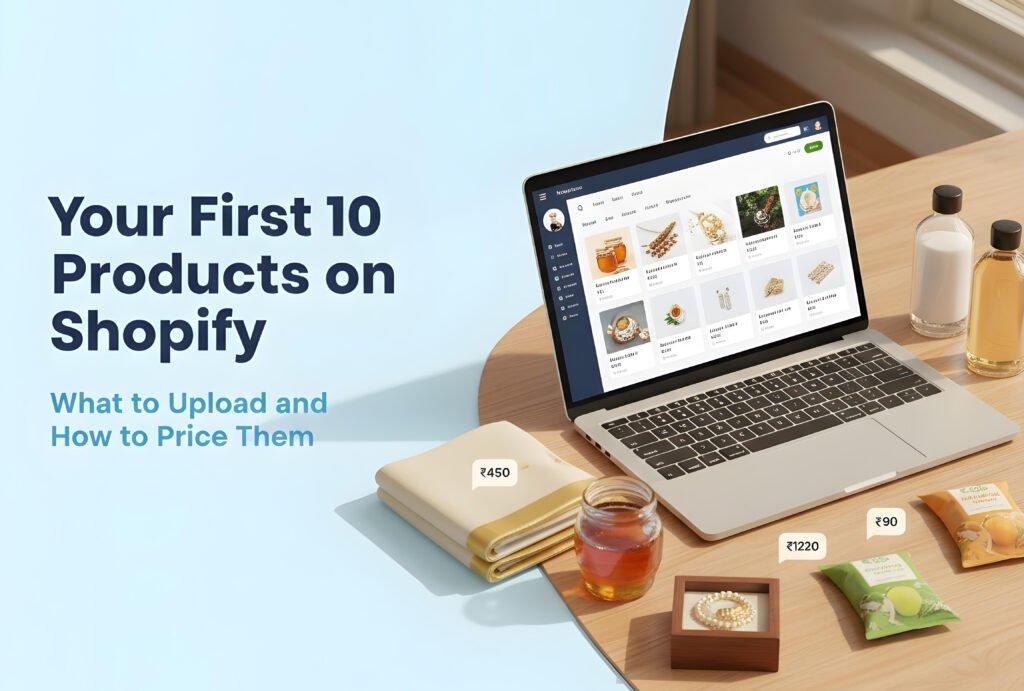
Your first 10 products should be your best 10 — your most popular, most photogenic, and most profitable items. Think of them as your store’s first impression. A tightly curated store of 10 great products always outperforms a cluttered store of 100 mediocre ones.
A complete Shopify product listing has 7 essential elements. Skip any one of these and you’re leaving money on the table.
Keep it clear and searchable. Include what the product is + a key detail. For example:
Write at least 150 words. Lead with a benefit, tell the story, list the specs, and end with a call to action. (See our previous blog on writing product descriptions for a full guide.)
Upload a minimum of 3 photos per product:
We cover pricing in detail in the next section. Never leave this blank or set it to zero.
Tell Shopify how many units you have. This allows automatic “Sold Out” labels which create urgency – and prevents you from overselling.
If your product comes in different sizes, colours, or weights, use Shopify’s Variants feature. Don’t create separate listings for the same product in different sizes – it fragments your store and confuses customers.
Scroll down to the bottom of the product page in Shopify and fill in the SEO fields. Most Kerala sellers skip this entirely. This is how Google finds your product. Include your main keyword naturally, like “Buy handmade Kerala pickles online” or “Kasavu saree shop in Kochi.”
Pricing is where most first-time Shopify sellers either undersell themselves or price themselves out of the market. Here is a simple framework used by our Shopify developers in Kochi when advising new store owners:
Scroll down to the bottom of the product page in Shopify and fill in the SEO fields. Most Kerala sellers skip this entirely. This is how Google finds your product. Include your main keyword naturally, like “Buy handmade Kerala pickles online” or “Kasavu saree shop in Kochi.”
| Product Type | Typical COG | Suggested MRP | Margin Notes |
| Handloom Sarees | ₹400–800 | ₹1,200–2,500 | Include weaving labour in COG |
| Homemade Pickles (500g) | ₹80–120 | ₹280–380 | Factor in glass jar cost |
| Coconut/Natural Oils (500ml) | ₹150–250 | ₹450–700 | COD return risk is higher for liquids |
| Handmade Jewellery | ₹200–500 | ₹700–1,800 | Premium packaging boosts perceived value |
| Ayurvedic Products | ₹100–300 | ₹350–950 | FSSAI/license compliance required for food/medicine |
| Fashion Apparel | ₹300–700 | ₹900–2,200 | Account for high return rates in apparel |
This is one of the most debated questions in eCommerce. Our recommendation for Kerala brands just starting out:
In Kerala, COD is still a major trust signal – especially for first-time buyers. However:
Once you’ve uploaded your first 10 products, group them into Collections – Shopify’s version of categories. Even 10 products should have 2–3 collections. For example:
Collections make your store feel organised and help customers find what they’re looking for quickly – which directly improves your conversion rate.
Before you share your store link with anyone, do this checklist:
1. Add a product to the cart and complete a test order (Shopify has a test payment mode)
2. Check that all products look correct on mobile — over 70% of Kerala shoppers browse on phones
3. Make sure every product has a photo, price, and description
4. Confirm your WhatsApp chat button is visible on every product page
5. Test the checkout flow all the way to order confirmation
Setting up your first Shopify store and getting the product listings right is the most critical step in your eCommerce journey. Get it right and you’re building a sales engine that works around the clock. Get it wrong and you’ll spend months wondering why visitors aren’t buying.
That’s why hundreds of Kerala brands trust ConvertEasy — the leading Shopify developers in Keral – to set up their store the right way from day one. Our starter package includes product uploads, payment setup, WhatsApp integration, and full post-launch support.
Let’s turn your brand into a 24/7 automated selling machine. Share your ideas, and we’ll craft the perfect Shopify solution for you.